When I learn something new and I want to "save it" in my brain, I need to be able to explain it or at least create something tangible with it.
In this article I'm writing about memory and how it is managed, but it won't deal with human memory. My goal is to make it easier to understand how Rust, one of the most trending programming language, deals with machine memory.
Rust as a programming language is somewhere in between:
- Low level. You'll need to manage memory manually (e.g in C you can use malloc and free);
- High level. Memory is automatically allocated and trash is taken out from time to time by someone else (gc).
So if I'm not required to manually manage memory and no one is going to do it, how does it work?
Please welcome to the stage Mr. Christopher Nol... Sorry, Ownership.
Now you're back from C.N. astonishing shots and before rushing into ownership concepts, let's see a couple of Rust's data types, how they are represented and allocated into memory.
fn main() {
    let greet = String::from("hi");
    let count = 10;
}
- The
greetvariable seems just aString, but in Rust strings are vectors with some extra guarantees, restrictions and capabilities. A vector orVec<T>is a dynamic size data collection; - The
countvariable is not using any constructor or type annotation, so it will be ani32by design. Ani32is a fixed size data type, specifically 32-bit signed integer.
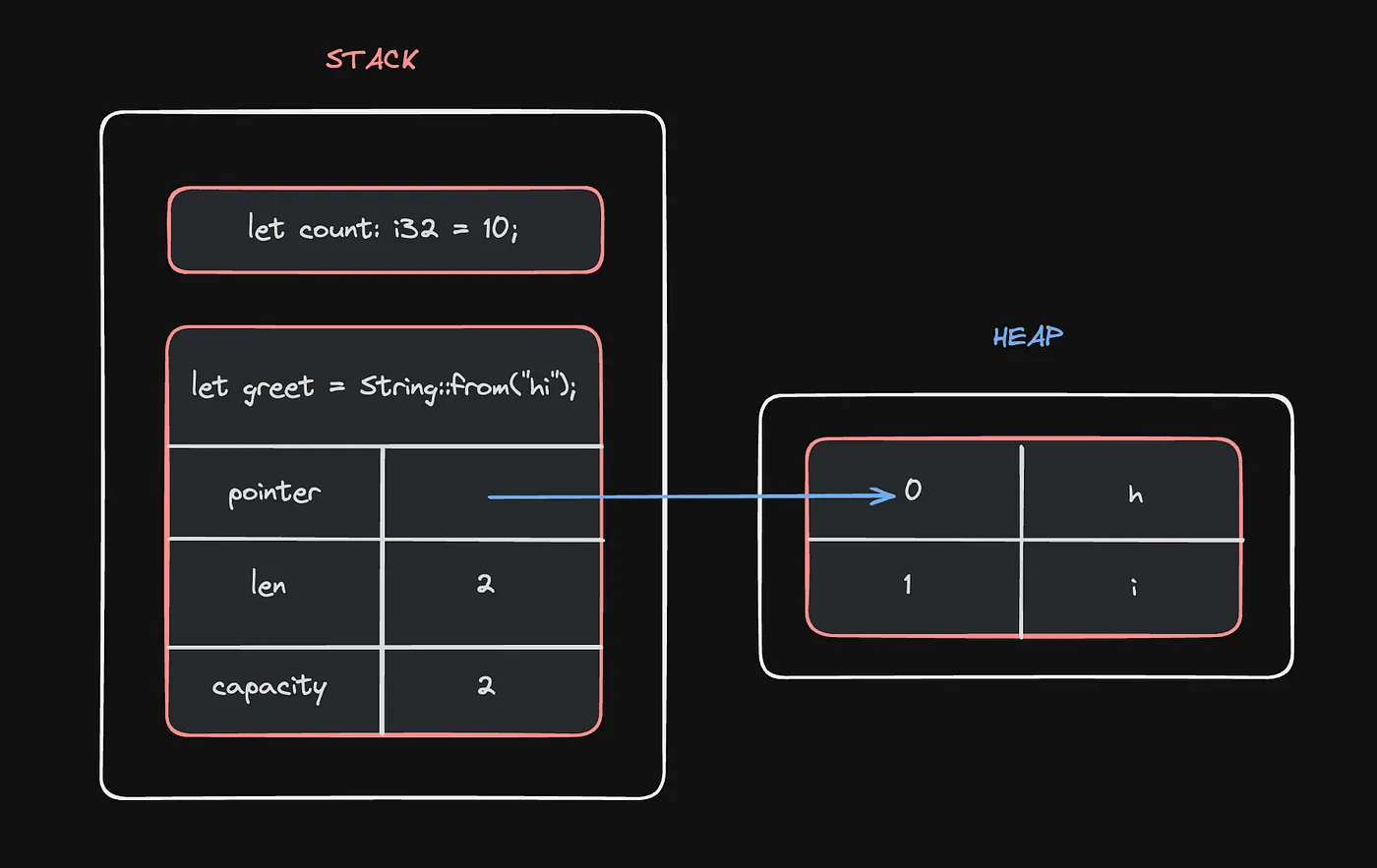
The dynamic and fixed size nature of the two variables helps us understand how they are allocated into memory:
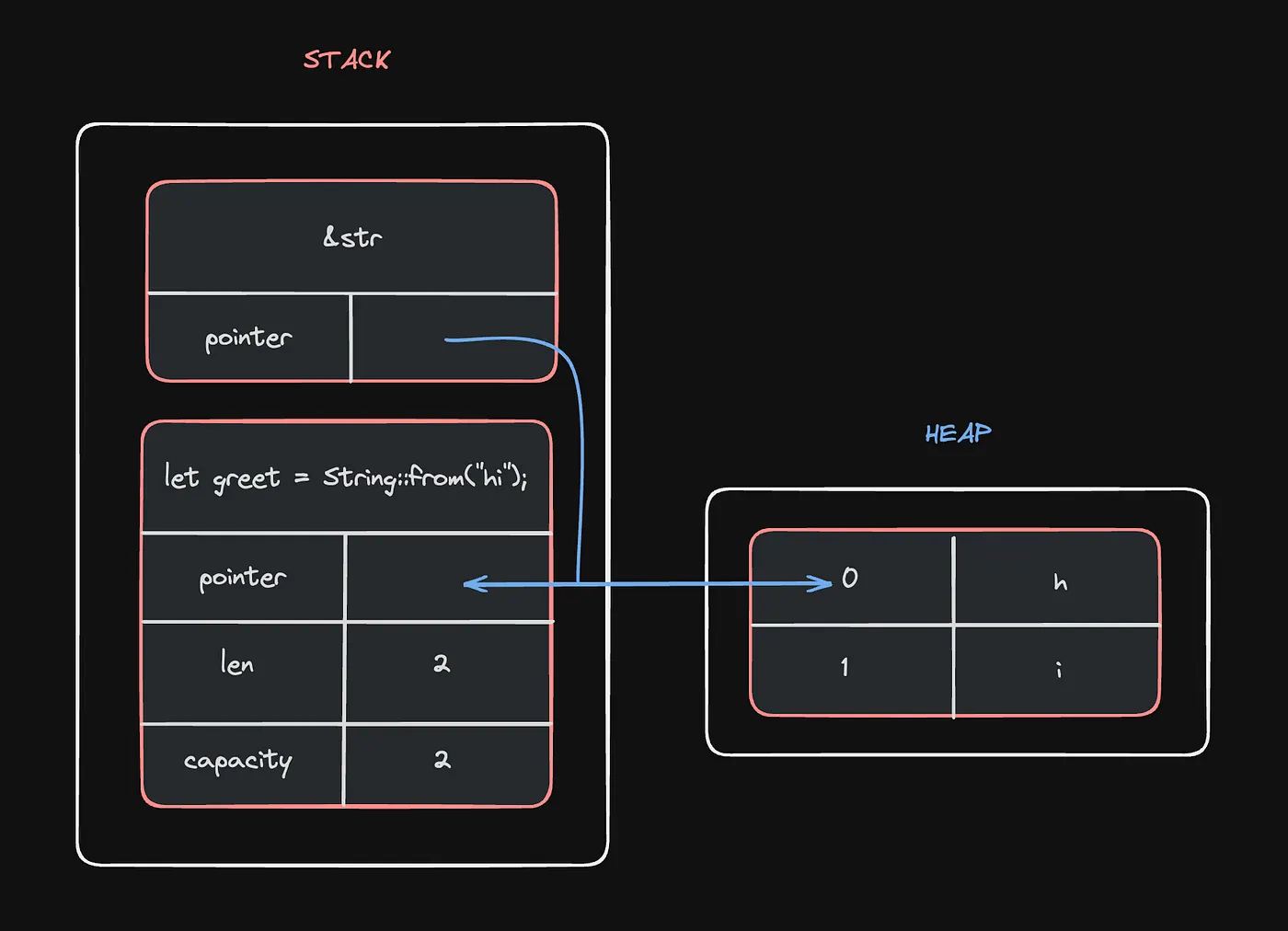
What's dynamic will be allocated in both the Stack and the Heap memory portion, linked by a (smart) pointer. What's fixed will be allocated only in the Stack memory portion.
Now we're ready to address Rust ownership.
It's a set of rules verified by the Rust compiler which ensures memory correctness and efficiency usage:
- Every value in your program has an owner;
- Every value in your program has exclusively one owner at any moment in time.
In the example above the count variable is the owner of the value of 10.
But our programs are not made by just two lines of code; how can the ownership be exclusive at any time of the code execution?
The ownership can be transferred or borrowed.
Value access and ownership transfer
Let's consider the following example:
fn main() {
    let first_counter = 10;
    let second_counter = first_counter;

    // ✓ compiles successfully
    println!("first_counter: {}", first_counter);
    println!("second_counter: {}", second_counter);
}
In this scenario we're dealing with two i32 fixed size variables. Both will be allocated in the stack and there are no pointers or references to the heap involved.
first_counteris the owner of the numeric value of10, but what is owning thesecond_countervariable?first_counter?
Nope, second_counter is the owner of another numeric value of 10.
The compiler is not dealing with any dynamic size variable, including pointers or references: it will just copy the value of 10 in the stack giving second_counter ownership.
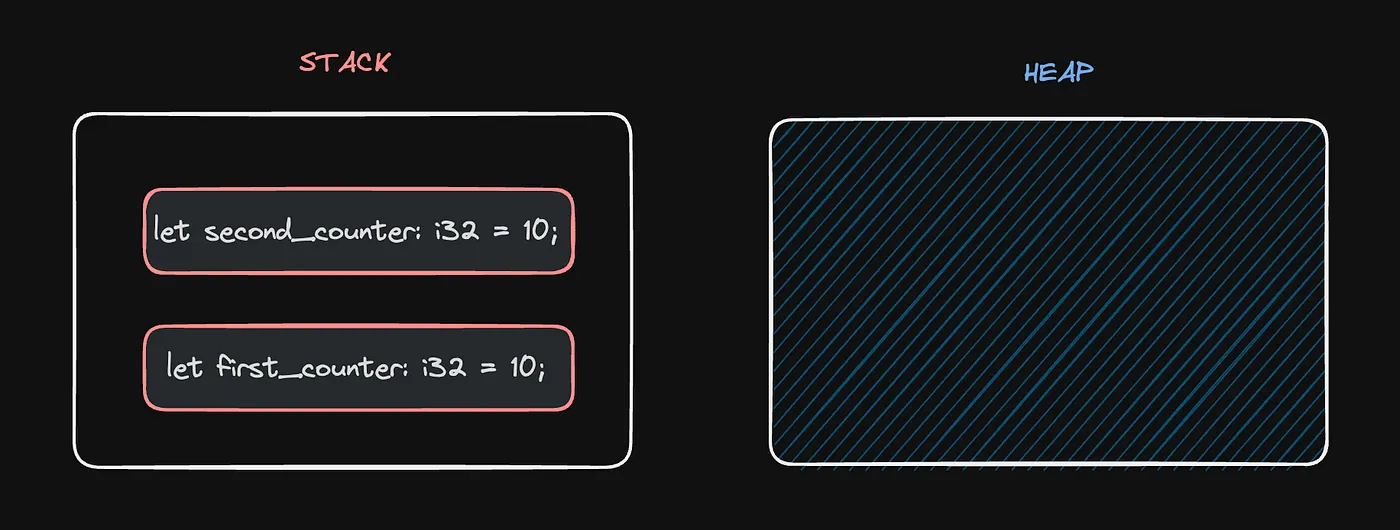
first_counter and second_counter are distinct variables, so the println! function can correctly access their values.
What happens in case of dynamic size variables instead? Something which deals with pointers, something like strings.
If strings behave the same, we would find ourselves in a situation like this:
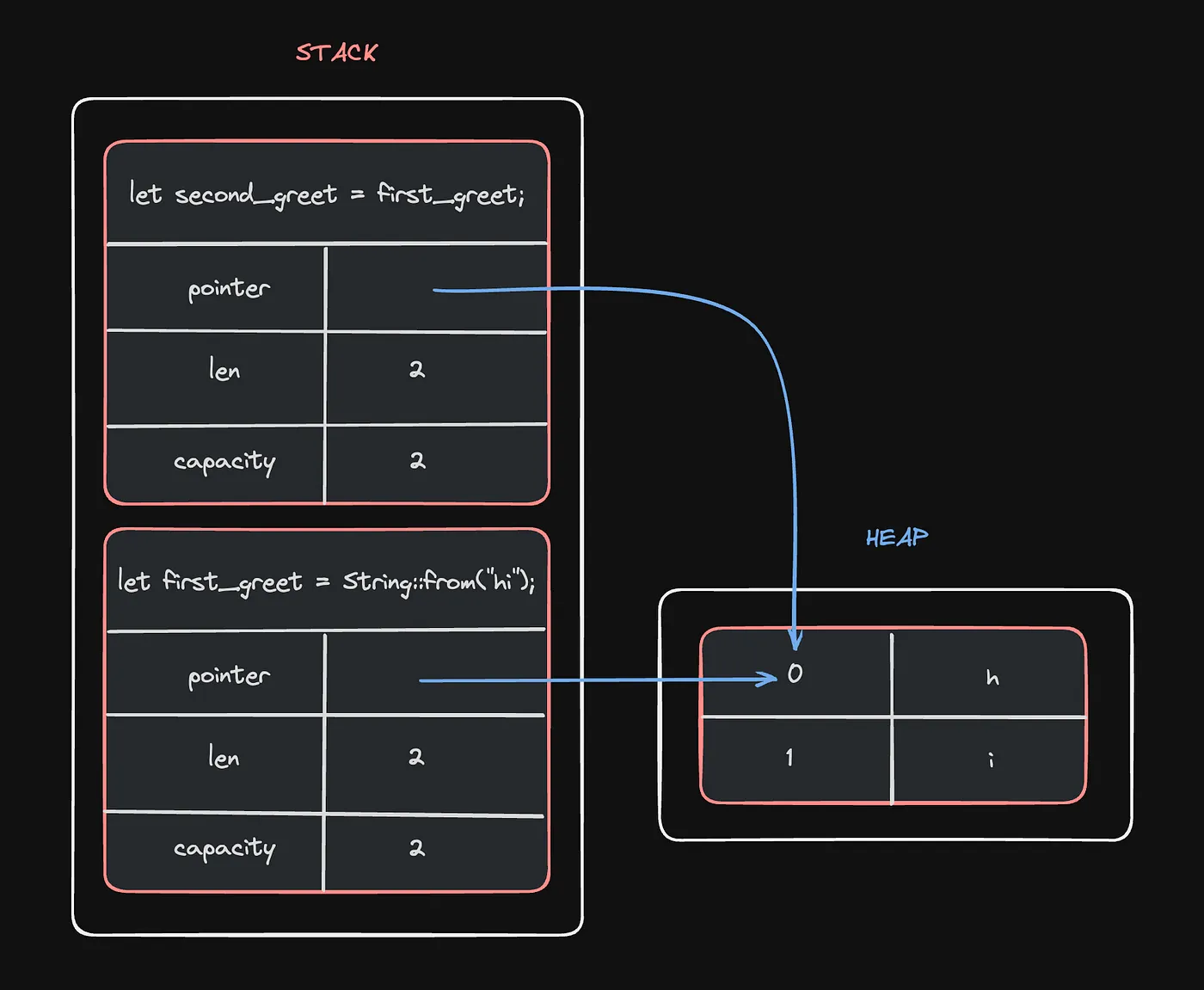
where freeing memory safely is not an option.
To address this issue Rust applies the ownership transfer.
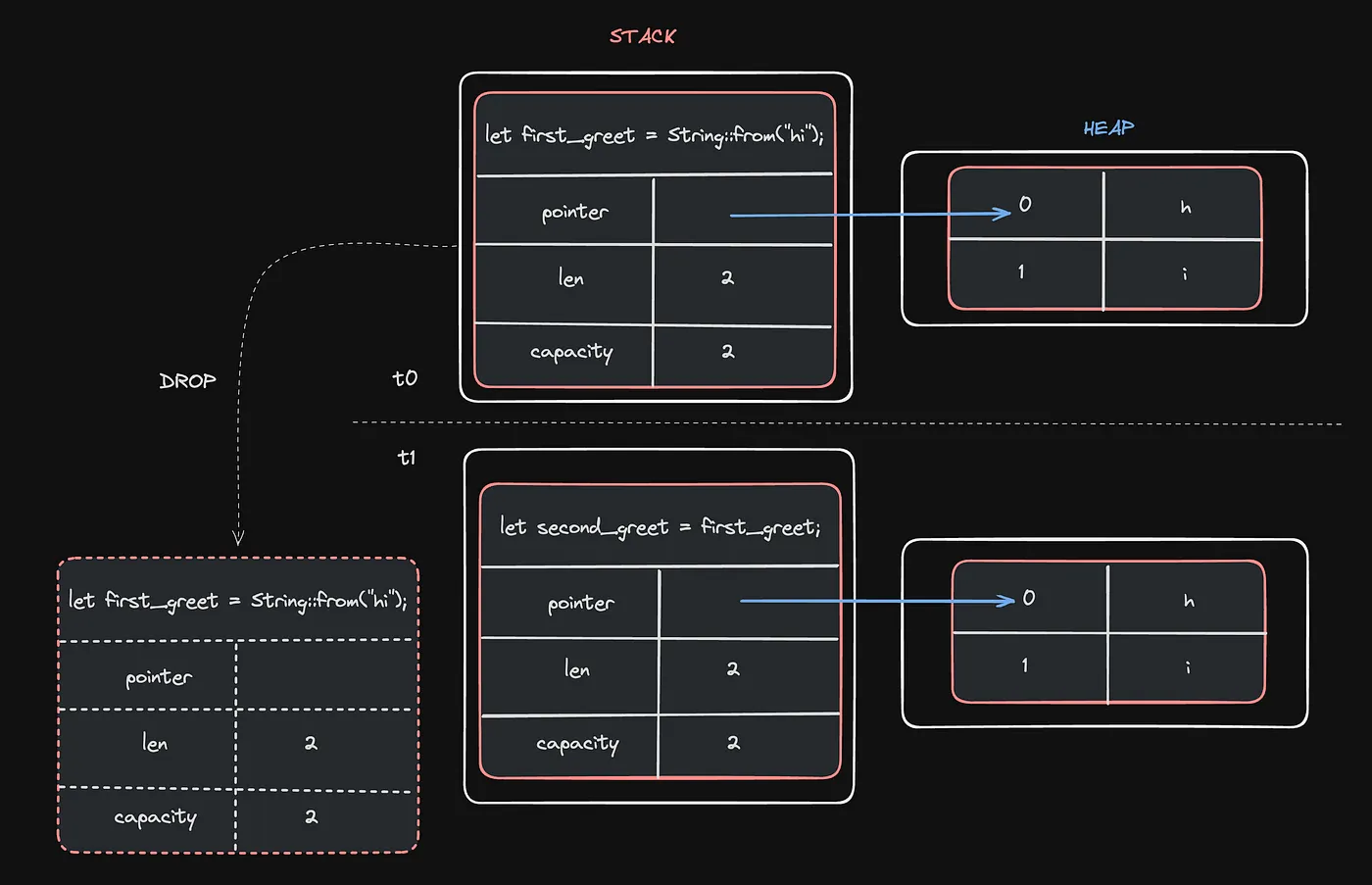
The hi value ownership has been transferred from first_greet to second_greet so:
- Accessing
first_greetwill be impossible; - The memory is efficiently and safely managed.
Like gravity moves across dimensions in Interstellar, ownership moves across variables, scopes and functions.
fn print_len(str: String) {
    println!("len: {}", str.len());
}

fn main() {
    let greet = String::from("hi");

    print_len(greet);

    // ✗ compile error
    println!("greet: {}", greet);
}
In the example above the hi value ownership has been transferred from the variable greet to the print_len function. greet access is no longer allowed by the compiler.
The fix can be more or less straightforward:
- Return ownership to the main function;
fn print_len(str: String) -> String {
    println!("len: {}", str.len());
    str
}

fn main() {
    let greet = String::from("hi");

    let same_greet = print_len(greet);

    // ✓ compiles successfully
    println!("same_greet: {}", same_greet);
}
- Borrow
greetvalue using a reference (known as borrowing);
fn print_len(str: &String) {
    println!("len: {}", str.len());
}

fn main() {
    let greet = String::from("hi");

    print_len(&greet);

    // ✓ compiles successfully
    println!("greet: {}", greet);
}
Borrowing
The latter would be better in readability and use-case terms. A simple print_len function should not return a value just to please the compiler.
The magic is possible thanks to the & operator.
You can find it in the print_len function signature indicating that:
print_lenexpects a reference to a string;print_leninvocation usinggreetstring reference won't transfer ownership, soprintln!greetvalue access is considered safe and the program will compile successfully;
Now it's time to take a break from our journey. A lot of questions may rise at this point. A lot of details like mutability and its ownership / borrowing influence, dereferencing and others have been left out to make this article readable yet exciting.
In case I don't see ya, good afternoon, good evening, and good night!